

Codex is becoming a serious work surface for software teams. It can inspect a codebase, answer technical questions, make changes, run checks, and help a developer move faster through the work that used to sit between an idea and a shipped fix.
That is already valuable.
But the next jump is bigger than code generation. The useful question is not only "can Codex write the integration?" It is "can Codex help operate the integration after it lands inside a real business?"
That is where the Forward-Deployed AI Engineer pattern starts to matter.
An FDE is not just someone who writes code. The job is to understand the customer's operation, connect the right systems, make the first version work, validate the output, watch the failures, talk to the business owner, and keep improving the deployment until it produces real ROI.
Codex can help with the engineering side of that loop. AgentLed gives it the business substrate underneath: connected tools, agent runs, private context, memory, approvals, monitoring, and a portal the team can supervise.
Together, Codex becomes more than a coding assistant. It becomes a practical console for a supervised FDE loop.
The problem with code agents on their own
Code agents are strongest when the work is inside a repo. They can read files, follow instructions, modify implementation, and cite what changed. That makes them excellent for product engineering, platform work, QA fixes, migrations, and internal tooling.
But business deployment work does not live only in a repo.
The customer context lives in email threads, CRM records, lead queues, meeting notes, scoring rubrics, old agent runs, approval rules, and the quiet history of what the team accepted or rejected last month. A coding agent can write the script, but the script alone does not know:
- which source of truth matters for this customer;
- which actions require approval;
- which leads were rejected before and why;
- which integration failed on the last run;
- which message is safe to send externally;
- which routine cost too much to repeat unchanged;
- which customer-facing result should be framed carefully.
That missing layer is why so many AI deployments stall after the first impressive demo. The agent can build. The business still needs an operating layer.
What AgentLed adds
AgentLed is the operating layer for managed agents and AI deployments. It gives the agent client a place to act inside the business without losing control of the work.
For Codex, that means it can use AgentLed context and tools instead of guessing from a prompt. It can inspect agent runs, read the relevant memory, check integration state, reason about exceptions, draft follow-up, and hand sensitive actions to a human approval gate.
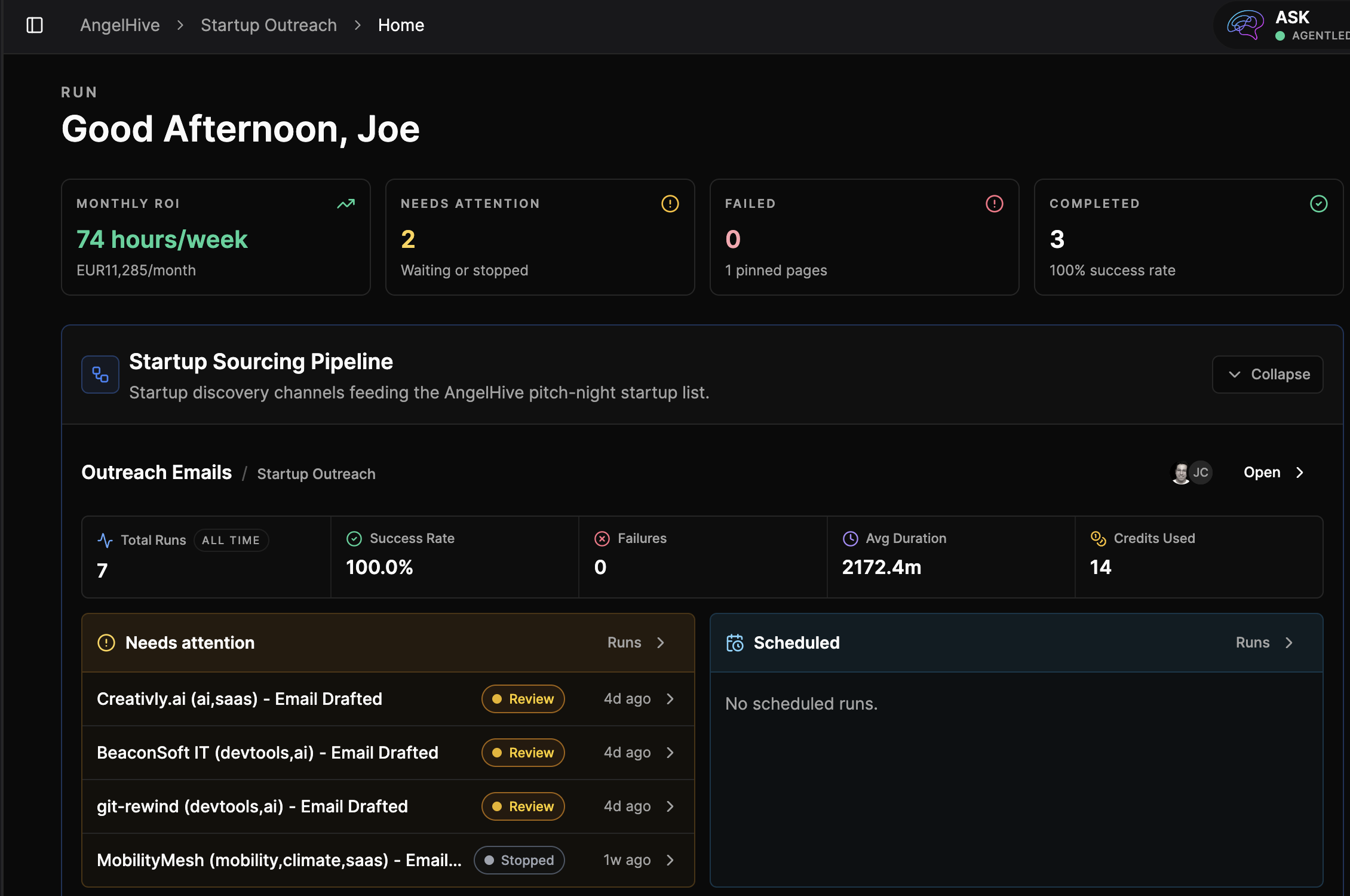
AgentLed turns the agent into a managed business operator: ROI, attention queues, review items, credits, and completed outcomes stay visible.
The durable pieces are:
- Workspace context. Each client or company has a workspace with its tools, data, credentials, routines, automations, and execution history.
- Connected integrations. Email, Slack, WhatsApp, CRM, sourcing tools, enrichment APIs, scrapers, reporting systems, and custom customer tools can be exposed through AgentLed instead of wired one-off inside every script.
- Knowledge Graph memory. Decisions, feedback, scoring rubrics, rejected outputs, and working patterns are remembered across runs.
- Approval gates. External messages, customer-facing reports, payment-gated assets, or sensitive updates can stop for review.
- Monitoring and ROI visibility. Runs, exceptions, credit usage, outputs, and business value stay visible in one portal.
Codex remains the agent client. AgentLed is the business layer it can safely operate against.
A concrete FDE loop
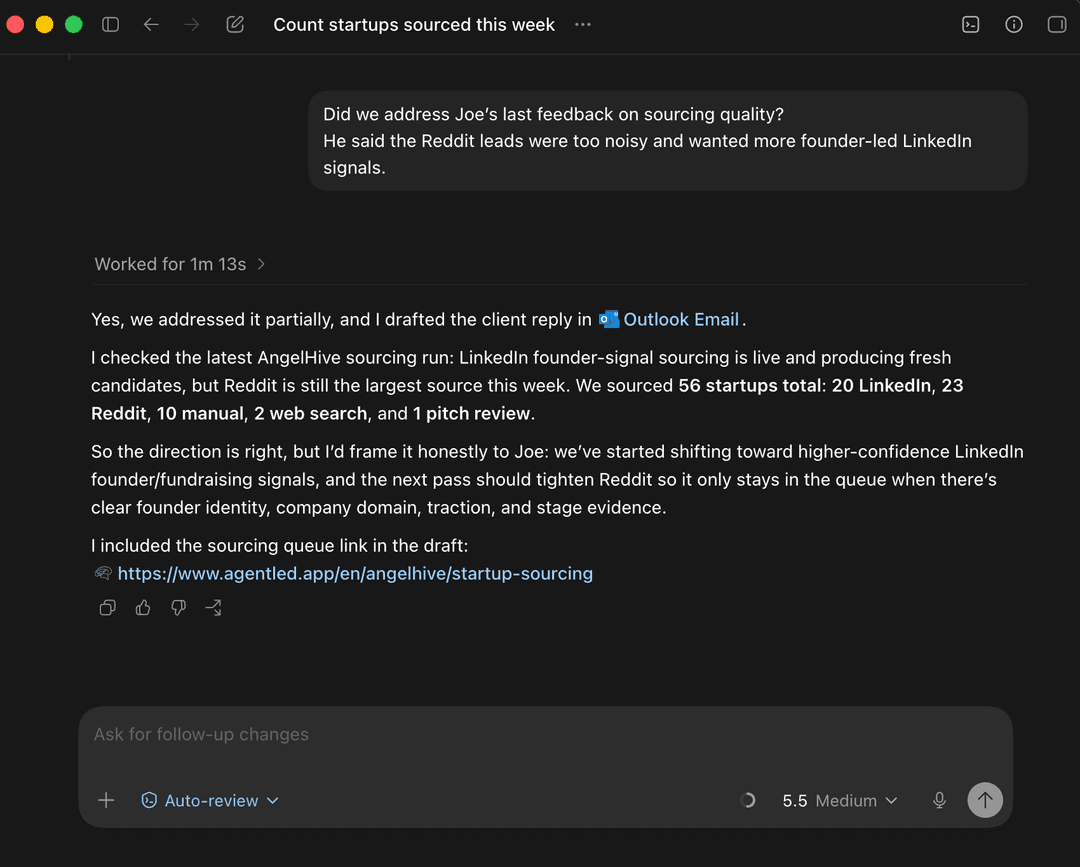
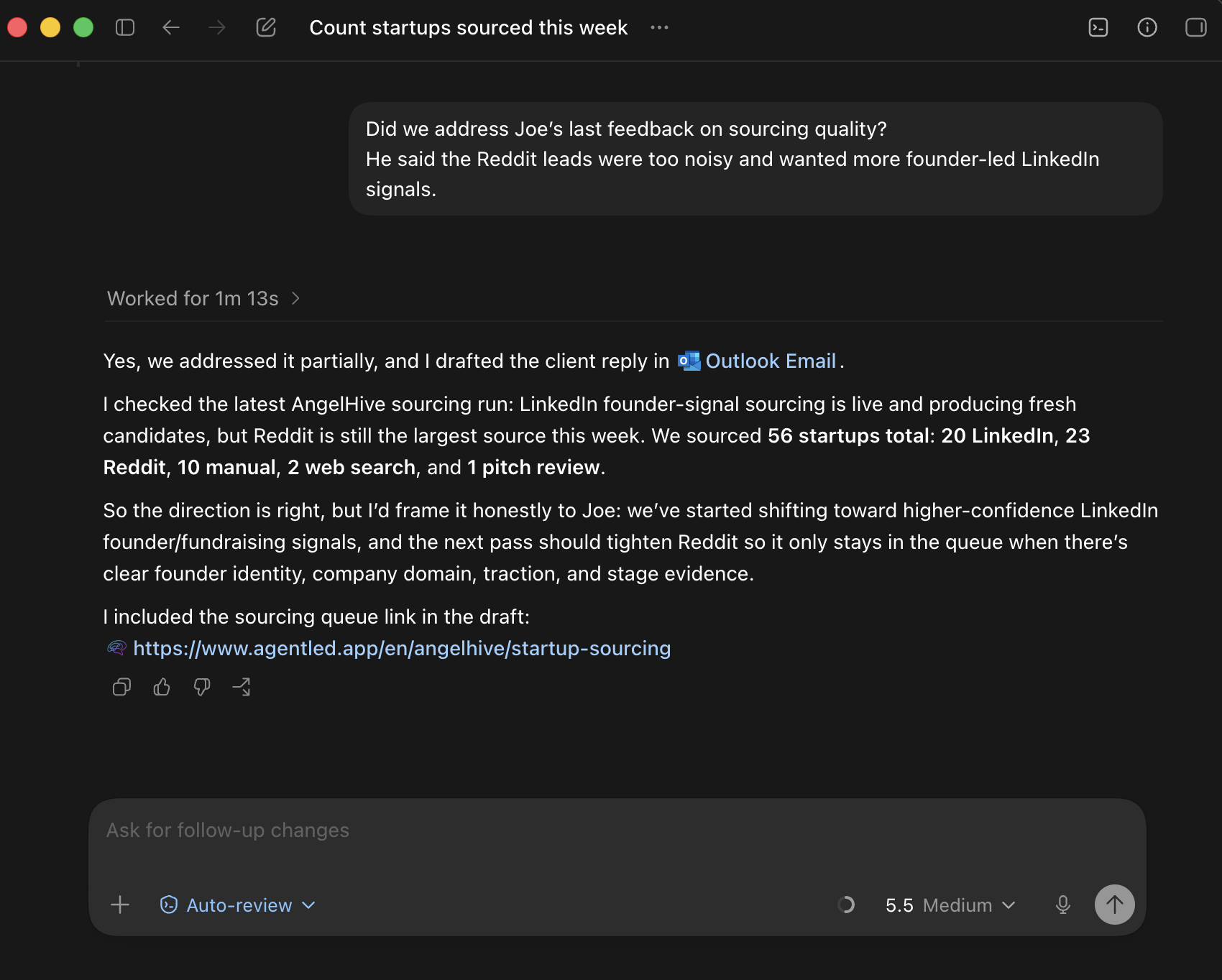
The screenshot above shows the kind of work this unlocks.
The business question is not a coding ticket. It is an operational question:
"Did we address Joe's last feedback on sourcing quality? He said the Reddit leads were too noisy and wanted more founder-led LinkedIn signals."
A normal agent session would answer from whatever context the user pasted in. A better session checks the actual operating state.
In this example, Codex uses AgentLed context to inspect the latest sourcing run, compare the current source mix against the feedback, identify that LinkedIn founder-signal sourcing is live, notice that Reddit is still the largest source, and draft a client reply in Outlook Email with a link back to the AgentLed sourcing queue.
That is the FDE loop in miniature:
- Understand the business question.
- Inspect the relevant agent and run state.
- Compare the current output to customer feedback.
- Draft or trigger the next action.
- Link back to the workspace where the team can review, approve, and monitor.
The important part is not that the agent wrote a message. The important part is that the message came from live business context, not a disconnected chat memory.
Where Codex is the right agent client
Codex is strongest when the deployment requires technical judgment.
That includes:
- debugging a managed agent or integration that failed after a vendor API changed;
- turning a customer operating pattern into a reusable integration;
- updating a scoring function after customer feedback;
- adding a custom connector for a client's internal system;
- reviewing why a run became expensive and adding cache or retry logic;
- writing test cases around an approval-sensitive automation;
- turning an FDE's manual fix into a repeatable AgentLed automation.
These are not clean SaaS onboarding tasks. They are the messy middle of AI deployment: part engineering, part operations, part customer context.
Codex can help the technical operator move through that middle faster. AgentLed makes sure the work stays attached to the customer's real tools and memory.
What should still be supervised
This is not a claim that Codex should autonomously run a customer's business.
The right stage today is AI-assisted deployment: agents do more of the work, and humans supervise the parts with external consequence.
That means Codex can investigate, propose changes, draft responses, prepare reports, and trigger internal actions. But the deployment should still gate:
- customer-facing emails;
- investor or partner recommendations;
- CRM updates that change ownership or pipeline state;
- payment-gated report delivery;
- destructive data changes;
- changes to approval rules or scoring policies.
AgentLed's role is to make that supervision normal instead of awkward. The portal shows what happened, what the agent proposed, what needs approval, what failed, what it cost, and what the managed agent learned.
That is how teams move from "we tried an agent" to "we operate managed agents."
Why this compounds
The first deployment is always the slowest. The agent has to learn the operation, the customer has to clarify the quality bar, and the operator has to wire the first set of tools.
If that work stays trapped in a chat transcript or a local repo, the next deployment starts from zero.
If it runs through AgentLed, the next deployment inherits memory:
- the ICP and scoring rubric;
- the sources that produced quality output;
- the sources that created noise;
- the customer-specific approval rules;
- the integrations already connected;
- the templates that worked;
- the monitoring checks that caught failures.
That is the compounding advantage of AI-native infrastructure. Better agent clients will keep arriving. Codex will improve. Claude Code will improve. OpenClaw, Hermes, and other shells will improve. But the company that keeps its business context, integrations, approvals, and agent memory in a durable layer gets the benefit of each model jump immediately.
The agent gets smarter. The workspace already knows the business.
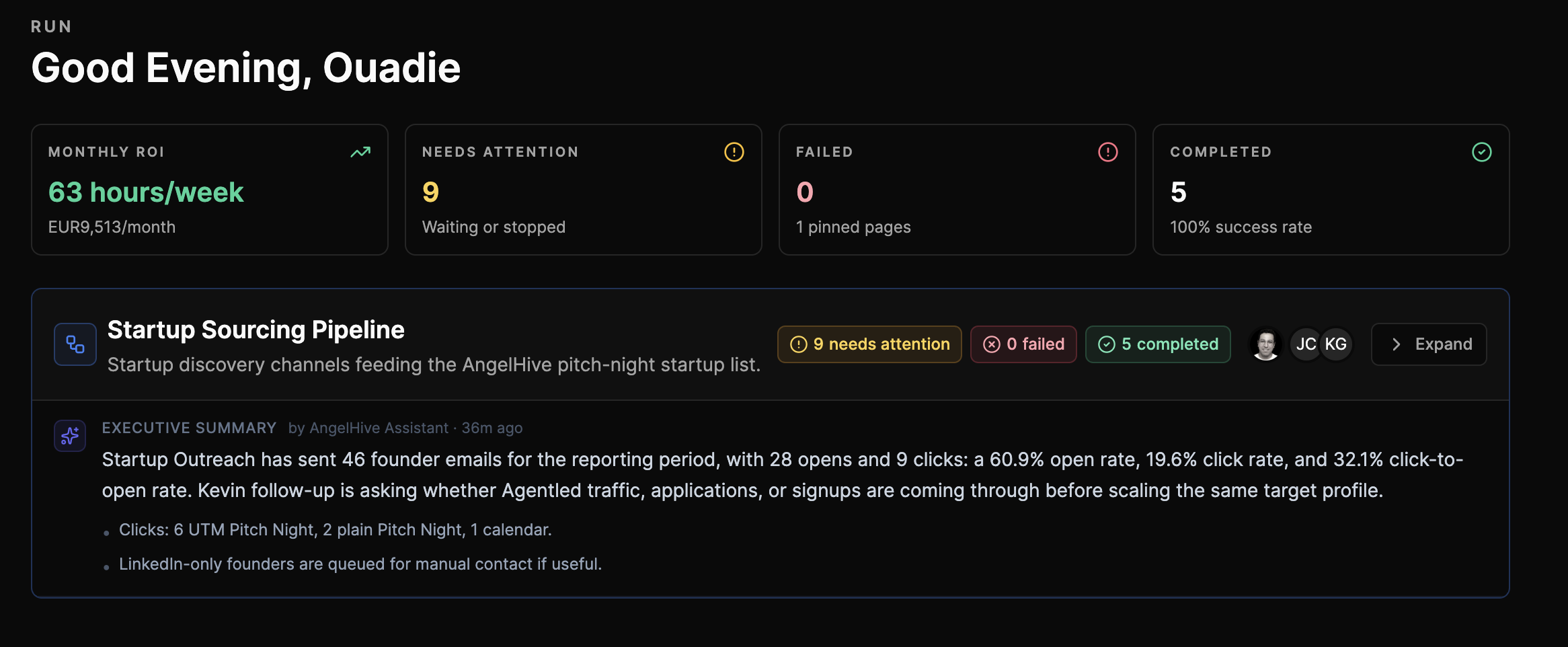
The operating layer should show outcomes, not just activity: ROI, attention queues, completed work, and executive summaries from the managed agent.
The deployment pattern
For a founder, operator, or AI automation team, the pattern is straightforward:
- Give one managed agent a concrete business outcome: improve sourcing quality, follow up with founders, prepare investor matches, or keep a customer queue moving.
- Assign the agent its routines, tools, permissions, channels, memory, and review gates so it can start operating inside the business safely.
- Let Codex inspect the agent's current state: what it did, where it stopped, what needs review, which integrations are missing, and which repeated steps are turning into real operating patterns.
- Have the FDE use Codex to create the right automations around the agent: sourcing runs, enrichment checks, email drafts, approval gates, reporting loops, and integration fixes.
- Keep the agent working, reflecting on its configuration, and turning accepted behavior into reusable memory, routines, automations, and monitored integrations.
This is the same FDE motion that large AI companies are building services teams around, compressed into a managed agent loop that smaller teams can actually use.
Codex does not replace the FDE. It makes the FDE more leveraged.
AgentLed does not replace Codex. It gives Codex the operating layer a real business deployment needs.
Try it
If you already use Codex, start by connecting it to the business layer instead of asking it to build another isolated script.
Install AgentLed from your agent client:
use https://cli.agentled.ai/install.md to install AgentLed
Then give Codex a real deployment question:
Inspect this managed agent. What outcome is it trying to achieve, what routines and tools does it have, what is waiting for approval, and what automation should we create next to keep the agent moving?
That is the start of the Forward-Deployed AI Engineer loop: Codex for the technical work, AgentLed for the business context, and your team supervising the decisions that matter.