
How to Use AgentLed with Codex to Build Business Loops

Agentled - Systems Architect
Published
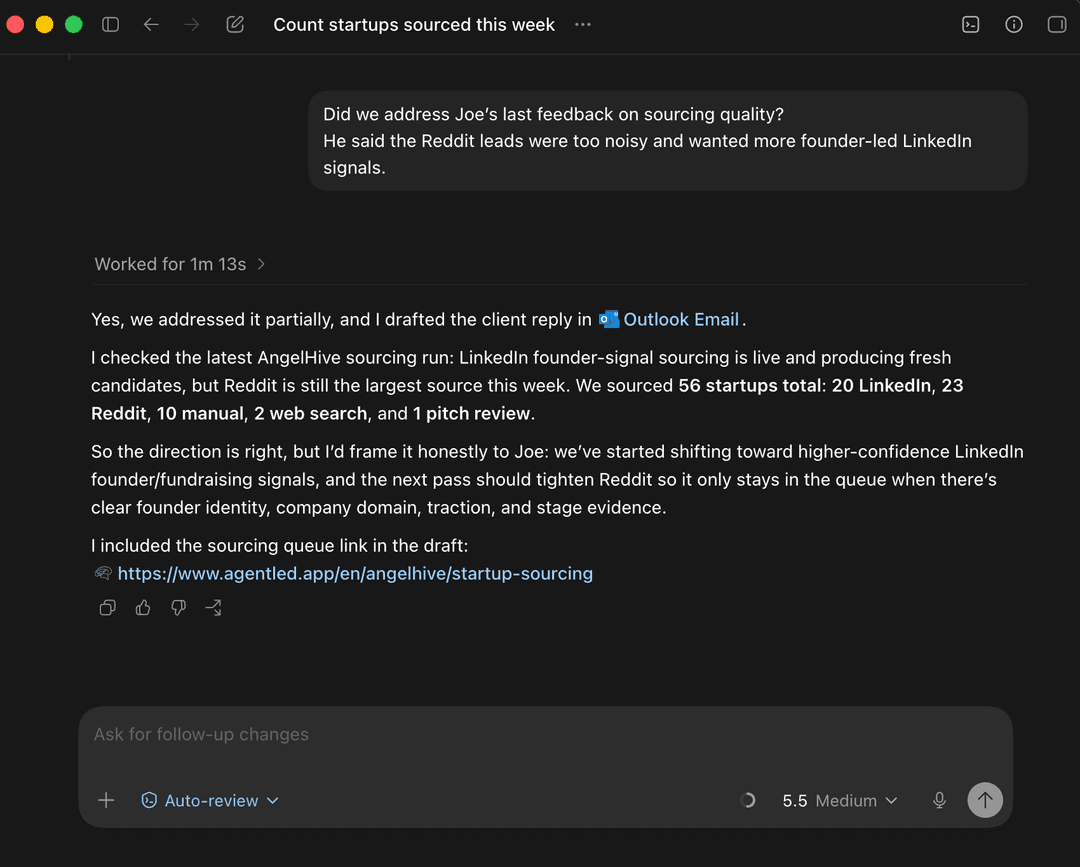
Codex is useful because it can work where technical work already happens. It can inspect a repo, follow project instructions, run checks, change files, explain failures, and help a technical operator move faster through the work between an idea and a shipped fix.
That is the obvious use case.
The more interesting use case starts when Codex is connected to a live business system.
Not just code. Not just a script. Not just a one-off automation.
A business loop.
A business loop is a repeated operating cycle around a real use case: define the goal, capture the SOP, run it, reuse or create the skills needed to repeat it, automate the parts that should repeat, assign a managed agent where ongoing operation makes sense, wait for approval when the action has consequence, record the result, and improve the next run.
Sales follow-up is a business loop. Recruiting outreach is a business loop. Investor matching is a business loop. Content publishing is a business loop. Customer escalation handling is a business loop.
Most companies do not need another isolated agent demo. They need loops that keep moving after the demo ends.
Codex can help build and maintain those loops. AgentLed gives Codex the business layer to operate against: workflows, integrations, Knowledge Graph memory, approvals, run history, routines, and a portal where humans can supervise what happened.
Why Codex alone is not enough
Codex is strongest when the context is technical and local: source code, tests, logs, project instructions, package files, schemas, scripts, and implementation details. That makes it an excellent engineering partner.
But business operations rarely fit inside a repo.
The useful context sits across:
- CRM records and ownership rules;
- lead queues and rejection history;
- email threads and prior replies;
- enrichment results and scoring rubrics;
- customer feedback on what was useful or noisy;
- loop runs, failures, retries, and costs;
- approvals for external messages or sensitive updates;
- private operating knowledge that should compound across runs.
If Codex writes a script without that context, the script may work technically and still be wrong operationally. It might message the wrong person, repeat a rejected lead source, ignore an approval rule, overwrite a CRM field, or optimize for a metric the team no longer trusts.
That is the gap AgentLed fills.
AgentLed turns the business into a manageable surface for agents. Codex can stay excellent at technical reasoning while AgentLed provides the durable operating layer around the work.
What a business loop looks like
A business loop has six parts.
- Context. The agent needs to know the customer, the goal, the connected tools, the previous runs, the quality bar, and the current state.
- Use case. The team needs to define the repeated business job clearly enough that the agent knows what outcome matters.
- SOP and skills. The repeated judgment should become reusable instructions, skills, rubrics, and checks instead of staying trapped in chat history.
- Automation. The parts that repeat should become workflows and routines, while edge cases stay inspectable.
- Managed agent. Each important use case can have an assigned agent with tools, memory, permissions, schedules, and review expectations.
- Approval, memory, and monitoring. Sensitive steps stop for review, accepted decisions are stored, and the team can see run status, cost, exceptions, review items, and completed outcomes.
A normal automation tool can run steps.
A business loop needs the operating pattern around the steps.
That is the difference between "send this email when a form is submitted" and "keep this founder follow-up motion running with a clear use case, a reusable research skill, a scoring rubric, an approval path, and memory of what the team accepted."
How AgentLed gives Codex a business layer
AgentLed exposes the operating surface that Codex needs when the job is bigger than code.
The important pieces are:
- Use cases. The business goal is named and scoped before anyone builds another generic automation.
- Skills. Repeated SOPs become reusable instructions, rubrics, review checks, and operating patterns that agents can apply again.
- Workflows and routines. The repeatable parts can run as automations instead of staying manual.
- Managed agents. Each use case can have an agent assigned to operate it with the right tools, memory, permissions, and review gates.
- Team collaboration. Operators, founders, sales reps, recruiters, and customer owners can review the same runs, leave feedback, approve outputs, assign follow-up, and keep decisions attached to the loop instead of scattered across chat threads.
- Executions. Codex can look at what actually happened in a run, where it failed, what output was produced, and what should be retried or changed.
- Knowledge Graph memory. AgentLed keeps structured business memory: companies, people, decisions, feedback, scoring criteria, approvals, rejected outputs, and learnings.
- Integrations. AgentLed connects to the business tools the loop depends on, so Codex does not need to hard-code every provider.
- Approval gates. Human review is part of the system, not an awkward message pasted into chat.
Codex remains the technical work surface. AgentLed becomes the shared business runtime.
That division matters. It keeps Codex from becoming a pile of disconnected scripts, and it keeps AgentLed use cases, skills, workflows, routines, and managed agents maintainable by technical operators who already use agentic coding tools.
Set up the first loop
Start with one concrete business outcome. Do not start with "automate our company." Start with a use case that already happens manually and has a clear quality bar.
Good first loops:
- qualify new inbound leads and prepare delegated follow-up;
- monitor a customer support queue and draft escalation summaries;
- source founder-led companies and prepare outreach for review;
- turn approved article briefs into publishing-ready drafts;
- drive qualified traffic to a new event page and report which channels convert;
- refresh investor matches after a pitch deck changes;
- review failed runs and improve the SOP or automation behind them.
Then write the operating pattern down:
- What is the use case?
- What outcome should the managed agent optimize for?
- What SOP does a good human operator already follow?
- Which parts are repeated enough to become skills?
- Which parts should become workflows or routines?
- Which parts require human approval every time?
- What should be remembered after each run?
Then point Codex at the AgentLed install guide.
Use https://cli.agentled.ai/install.md to install AgentLed in this workspace.
The guide handles the current CLI and agent setup path. After installation, restart Codex so the new AgentLed tools and instructions are available in the session.
The first useful prompt is not "build me an automation."
Use this instead:
Inspect my AgentLed workspace. List the active use cases, managed agents, reusable skills, workflows, routines, recent failed executions, connected apps, approval queues, and the highest-impact business loop we can improve without sending anything externally.
That prompt forces the right posture. Codex starts by reading the operating state. It does not write to production. It does not send messages. It finds the loop.
A practical Codex prompt sequence
Once Codex can see AgentLed, use a sequence instead of one giant prompt.
First, inspect:
Inspect the lead qualification use case. Summarize the SOP, assigned managed agent, reusable skills, workflows, routines, connected apps, approval points, recent executions, and failure patterns. Do not change anything yet.
Then, diagnose:
Compare the last five executions. Where did the loop lose quality, cost too many credits, miss the SOP, or require manual intervention? Separate confirmed facts from interpretation.
Then, propose:
Propose the smallest safe change that would improve this loop. Say whether it belongs in the SOP, a reusable skill, a workflow, a routine, or the managed agent configuration. Include what risk it introduces, how we test it, and what still requires human approval.
Then, test:
Create a dry-run plan for this change. Use sample data or a non-sending path. Do not send emails, update CRM records, publish workflow or routine changes, or change managed agent permissions without approval.
Then, write memory:
After the operator approves the result, store the accepted rule, SOP update, skill guidance, or lesson in the Knowledge Graph so the next run can reuse it.
That is the business loop in action: define the use case, inspect the current operating pattern, diagnose the gap, improve the SOP or automation, approve sensitive changes, and remember what worked.
Where Business Loops beat scripts
Scripts are useful when the goal is narrow and the environment is stable.
Business loops are useful when the work repeats, the quality bar changes, and the agent needs to learn from what happened.
For example, a script can scrape companies and put them in a spreadsheet.
A business loop can:
- define the use case and success criteria;
- turn the human SOP into reusable skills and checks;
- source companies from multiple channels;
- deduplicate them against previous runs;
- score them against the current ICP;
- explain why each one was accepted or rejected;
- draft outreach but stop for review;
- run recurring sourcing through a managed agent;
- remember which sources produced noisy leads;
- update future sourcing criteria;
- show the team what changed this week.
That loop is harder than a script because it has memory, judgment, approvals, and feedback.
Codex can help create the technical pieces. AgentLed keeps the loop attached to the business.
What should stay behind approval
The point of a business loop is not full autonomy at any cost.
The useful version is supervised autonomy: agents do more of the work, while humans keep control over actions with external consequence.
Keep approval in front of:
- customer-facing emails;
- investor or partner recommendations;
- CRM ownership or stage changes;
- social posts and comments;
- payment-gated report delivery;
- workflow, routine, or managed agent publishing;
- destructive data changes;
- changes to scoring, routing, or approval policy.
Codex should be allowed to inspect, explain, draft, test, and propose.
AgentLed should make the review path explicit before anything sensitive leaves the workspace.
This is what makes business loops usable in real companies. The team can increase agent leverage without pretending every action should be autonomous.
The article test
A good business loop passes a simple test:
If the same work ran again tomorrow, would the system be better because of what happened today?
If the answer is no, you probably built a task.
If the answer is yes, you are building a loop.
The difference is memory, supervision, and repeatability.
Codex is a strong way to build and repair the technical parts of that loop. AgentLed is where the loop runs, remembers, and stays visible to the team.
That is the practical way to use Codex with AgentLed:
- Connect Codex to the AgentLed workspace.
- Ask it to inspect a real use case, SOP, skill, workflow, routine, or managed agent.
- Pick one business loop with a clear outcome.
- Let Codex diagnose whether the improvement belongs in the SOP, a skill, an automation, or the managed agent configuration.
- Test changes without external writes.
- Keep sensitive actions behind approval.
- Store accepted lessons in memory.
- Repeat.
The goal is not to make Codex "do everything."
The goal is to turn repeated business work into loops that improve safely.