LangGraph Alternative
LangGraph handles the graph.
AgentLed handles everything else.
LangGraph — part of the LangChain ecosystem — is a powerful Python and JavaScript library for defining agentic execution graphs in code. It gives engineers precise control over agent topology. AgentLed is the production layer on top of those patterns: no-code orchestration, 100+ integrations, built-in Knowledge Graph memory, white-label deployment, billing, human-in-the-loop, and a native MCP server — all without writing graph topology code.
The core difference
LangGraph
Code-First Graph Library
You define nodes, edges, and conditional transitions in Python or JavaScript. Full programmatic control over agent topology. Every integration, state store, and UI must be built and maintained by your engineering team.
AgentLed
Production Orchestration Layer
No-code workflow builder plus MCP. 100+ integrations via a single credit system. Knowledge Graph memory built in. White-label, billing, and human-in-the-loop included. Deploy without engineering involvement.
At a glance
| Dimension | AgentLed | LangGraph |
|---|---|---|
| Who deploys it | No-code builder + MCP — anyone on your team can deploy without engineering involvement | Python / JavaScript library — engineers must build, deploy, and maintain everything |
| Integrations | 100+ integrations via one shared credit system — no API key setup per service | No built-in integrations — you wire every external API and service yourself |
| Persistent memory | Knowledge Graph built in — entities, relationships, and learnings persist across every run | No built-in state store — you implement and host your own persistence layer |
| Production layer | White-label, billing, and human-in-the-loop UI all included out of the box | None included — white-label, billing, and HITL UI must be built from scratch |
Full feature comparison
| Feature | AgentLed | LangGraph |
|---|---|---|
| Setup | No-code builder — describe the workflow in natural language, AI builds it; no library to install | Install via pip or npm, define graph topology in code, manage dependencies and environment |
| Integrations | 100+ integrations via one shared workspace credit system — no API key management | No built-in integrations — you write the API calls, handle auth, and maintain each connection |
| Persistent Memory | Knowledge Graph stores entities, relationships, and learnings across every run — workflows improve over time | No built-in memory — you implement your own state store using Redis, PostgreSQL, or similar |
| MCP Support | Native MCP server — connect Claude Code, Cursor, Codex via npx -y @agentled/mcp-server | No MCP integration; workflows are invoked via Python/JS code only |
| White-Label | Full white-label: custom domain, logo, colors — client-ready in minutes | No white-label; no UI layer — you build the entire frontend yourself |
| Human-in-the-Loop UI | Built-in approval gates — AI drafts, reviewers approve or reject before execution continues | Interrupt/resume patterns available in code; no built-in UI for non-technical reviewers |
| Billing Layer | Shared workspace credits with usage dashboards — ready to expose to clients or internal teams | No billing layer; you build metering, invoicing, and usage tracking from scratch |
| AI Model Routing | Multi-model routing (Claude, GPT, Gemini, Mistral, DeepSeek) — each step uses the best model | Any model available via LangChain integrations, but routing logic is your responsibility to write |
| Self-Hosted | Cloud (enterprise on-premise available) | You host everything; no managed cloud option |
| Open Source | MCP server is open source on npm | Open source (MIT); full source available but no managed production layer |
When to switch to AgentLed
Your team doesn't want to maintain agent infrastructure
LangGraph is a library — not a platform. Every integration, state store, HITL UI, and billing layer you need must be built by engineers. AgentLed ships all of that out of the box so your team can focus on the workflow, not the infrastructure.
You need 100+ integrations without API key setup
LangGraph has no built-in integrations. AgentLed connects to over 100 services via a single shared credit system. No auth configuration, no key rotation, no per-service maintenance.
Workflows need to remember across runs
LangGraph gives you the primitives to build a state store — but you build it. AgentLed's Knowledge Graph persists entities, relationships, and context automatically across every execution. Agents accumulate knowledge without extra code.
You want white-label, billing, and HITL without building them
If you're delivering AI workflows to clients or internal stakeholders, AgentLed includes white-label deployment, usage dashboards, and human-in-the-loop approval UIs. LangGraph provides none of these — you start from zero.
You use Claude Code, Cursor, or Codex
AgentLed ships a native MCP server. One command and your AI coding environment can trigger, inspect, and manage workflows without leaving the editor. LangGraph workflows are invoked through code only.
When to stay on LangGraph
- •You need full programmatic control over agent graph topology — custom nodes, conditional edges, and state transitions defined precisely in code
- •You have engineering resources dedicated to building and maintaining the agent infrastructure long-term
- •You are building highly custom agent architectures that don't fit a no-code model — multi-agent supervisors, dynamic graph construction, or research-grade experiments
- •Your team is already deep in the LangChain ecosystem and the switching cost outweighs the platform benefits
Native MCP server
AgentLed ships an open-source MCP server. Install it once and your AI coding environment — Claude Code, Cursor, Codex, Windsurf — can trigger, inspect, and manage workflows without leaving the editor. LangGraph workflows are only accessible through code.
npx -y @agentled/mcp-server
Works with Claude Code, Cursor, Codex, Windsurf, and any MCP-compatible client.
Product evidence
A real supervised AgentLed workspace
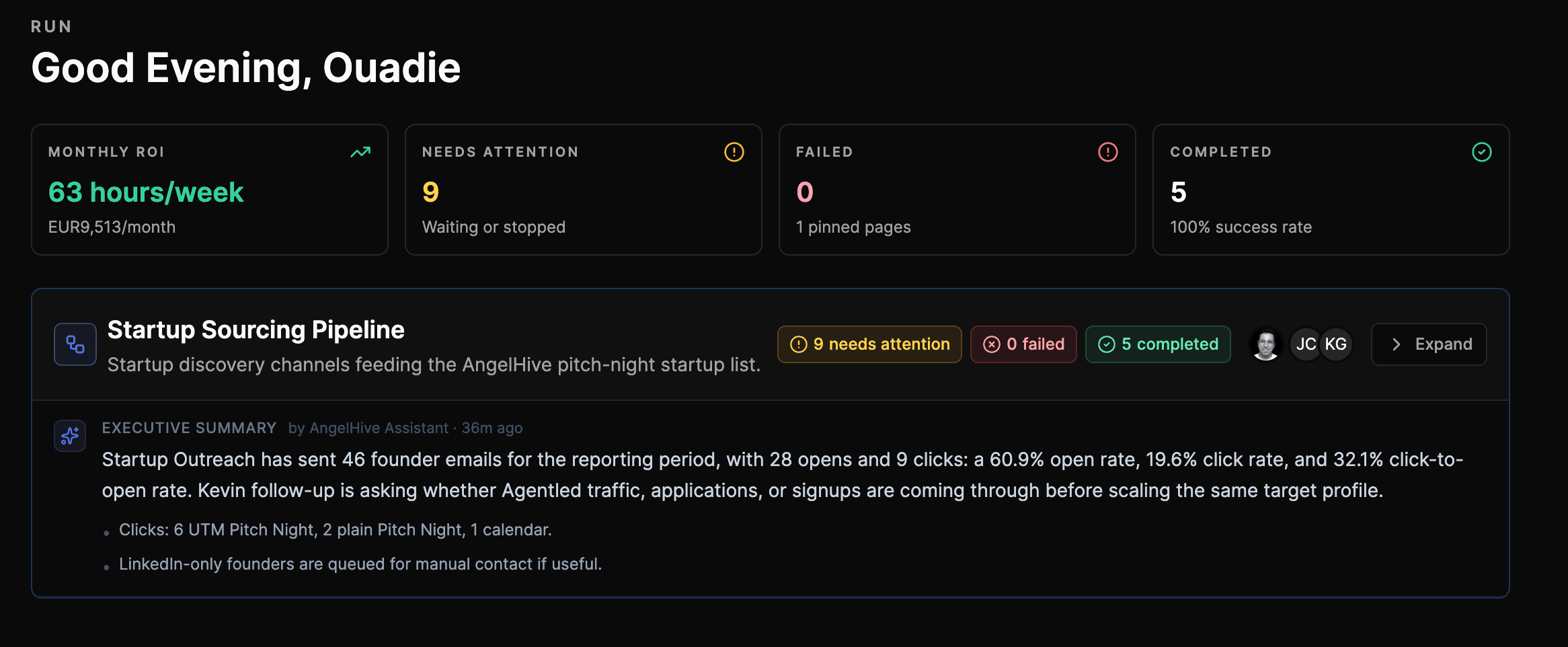
This customer workspace shows execution health, work waiting for review, completed runs, and ROI reporting in the same operating view.
Comparison claims are reviewed against current public product documentation and hands-on AgentLed product use. Pricing and packaging can change; verify them with each vendor before purchasing.
Reviewed by Ouadie BOUSSAID ·
Ready to try it?
Set up your first AgentLed workflow in 5 minutes. If you want to talk through how your LangGraph patterns map to AgentLed's orchestration model, book a call.